Zhongbai Robot is a Suzhou-based non-standard linear module integrator. We focus on custom integration of timing-belt silent modules (ZW/A series) and rack-and-pinion modules (KCT22) — connecting specification, machining, and assembly into one deliverable, rather than only selling the module itself. The gap we sit in: large module makers run batch production and avoid non-standard orders; small shops take non-standard work but are short-staffed and slow. Zhongbai operates in between. That middle position is what "non-standard linear module integrator" means in this article. The selection rule for a non-standard linear module integrator: judge by how much of that chain it actually owns, not by how many pages its catalog has. Below we answer the questions buyers actually ask a non-standard linear module integrator — custom lead time, achievable accuracy, and how to vet a supplier.
What is non-standard linear module integration?
It is the process of combining the module body, motor, drive, and limit switches into a ready-to-mount unit, built around the device's actual stroke, load, and mounting method. Unlike standard parts, the number of carriages, stroke length, and structural parts are all customized to the customer's drawing.
Why don't large module makers take non-standard orders?
Large makers schedule by batch. Changing a drawing and tooling only pays off when the cost is spread across dozens or hundreds of units. A one-off or few-unit non-standard job is a loss-making order for them, so they set minimum order quantities or decline outright. This is not a technical limitation — it is a production-model issue.
Why can't small shops deliver fast?
Small shops are thin on staff: quoting, procurement, and assembly are often handled serially by the same people, so one stalled step delays everything. Accuracy consistency also leans on individual workers' experience, which varies batch to batch. Typical non-standard lead time runs [TBD] weeks or more; rush jobs are basically not accepted.
Where does integration capability show?
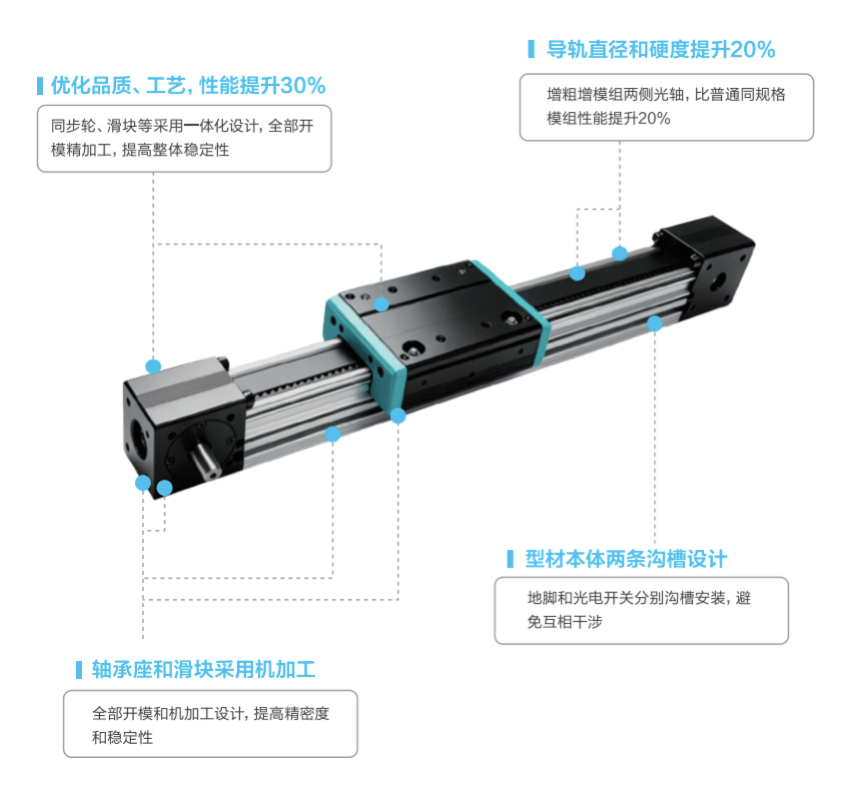
Three points: ① In-house module body — the ZW/A timing-belt silent modules and KCT22 rack-and-pinion modules have controllable underlying parameters; ② carriage count, mounting holes, and stroke are built to drawing, so the customer does not redesign their machine to fit the module; ③ specification, machining, and assembly are done in one place in Suzhou, with no subcontracting and no passing the buck.
(Figure: non-standard linear module integration flow, schematic)
How long does a custom linear module usually take?
Typical cycle: standard products ship in [TBD] business days; non-standard customization takes [TBD] weeks. Because Zhongbai makes the module body in-house and keeps every step internal, we can hold specification-to-shipment within [TBD]. Final lead time is confirmed in writing after drawing review — verbal promises do not count.
What accuracy can a custom module reach?
Accuracy is decided by both the module body and the assembly. The ZW/A series repeatability is [TBD]; the KCT22 rack-and-pinion module repeatability is [TBD]. When requesting a quote, ask whether the number given is "repeatability" or "positioning accuracy" — the two are often mixed up, and the values differ significantly.
How to tell if a non-standard linear module integrator is professional?
Use 4 verifiable questions: ① Does the integrator make the module body in-house? ② Can they issue 2D/3D confirmation drawings before production? ③ Does each unit ship with an individual accuracy inspection record? ④ Is the lead time written into the contract? Suppliers that answer "yes" to all four are noticeably lower-risk.
What should a buyer prepare before contacting an integrator?
Prepare 4 pieces of information: load weight, effective stroke, travel speed, and a dimensional drawing of the installation space. The more complete the data, the fewer redesign rounds. Missing load and stroke alone usually makes a one-shot correct solution impossible, and later drawing changes are typically borne by the buyer.
Closing
The hard part of non-standard module integration is not any single technology — it is who owns the "specification—machining—assembly" chain end to end. When choosing a supplier, ask the 4 questions in Section 7 first, then compare price. Do not reverse the order.
Internal links
- Products: https://www.zenbotsmart.com/en/products